
Good orthopedic website design routes each patient by body part, procedure and urgency, then makes booking easy on a phone. The strongest sites separate same-day injury care from routine appointments, show each surgeon's training, and give every major procedure its own page.
- Organize the site by body part, condition, procedure, surgeon and location so patients find the exact match.
- Separate same-day injury care from routine booking, as Rothman and OrthoCarolina do.
- Show each surgeon's fellowship training, board certification and the procedures they perform.
- Pass Core Web Vitals and keep ad pixels off intake, imaging upload and appointment forms.
- Grow with local SEO, procedure-focused paid search, policy-compliant reviews and physician referrals.
What should an orthopedic website do that a general medical site doesn’t?
An orthopedic website has to sort patients by body part, urgency and treatment stage. It should route an injured athlete to same-day care, a joint-pain patient to the right subspecialist, and a surgical candidate to a consultation, while proving each surgeon’s training and the procedures they actually perform.
That is a harder job than most practice sites face. Orthopedic patients range from a weekend runner with a rolled ankle to a 70-year-old weighing knee replacement, and many arrive by referral from a primary care physician. The site has to serve all of them without becoming a maze.
For this article, we reopened every orthopedic site from our earlier roundup in October 2026 and checked each live homepage. We kept the ones that still hold up, dropped the ones that had slipped or drifted outside orthopedics, and added two large group practices that show what scale looks like. We describe only what is visible on each site.
- Body part
- Condition or injury
- Urgent or routine
- Right surgeon
- Book
Which orthopedic websites are worth studying?
These five sites range from a single foot and ankle surgeon to regional groups with dozens of offices. Each shows a pattern you can apply at your own size. Open them on a phone, since that is how most of your patients will see yours.
1. Nutley Orthopaedic Group (Nutley, NJ)
Nutley Orthopaedic Group uses a utility bar for the three tasks existing patients need most: “Pay Online,” “Patient Forms” and “Request Appointment.” The main menu then focuses on doctors, services and testimonials, with a patient portal and a financing link alongside.

Services are split the way patients think about them: joint replacement (anterior hip, same-day partial knee, shoulder replacement) and sports medicine and arthroscopy (ACL and meniscus repair, rotator cuff repair, shoulder stabilization). The header lists separate numbers for new and existing patients, and the hero promises a return to “an active lifestyle,” which is the outcome patients want.
2. J. Turner Vosseller, MD (foot and ankle, Jacksonville, FL)
J. Turner Vosseller, MD is a strong model for a single-surgeon subspecialty site. The hero, “Respected leader in foot and ankle surgery,” is paired with a patient quote about getting back to activity without foot pain.
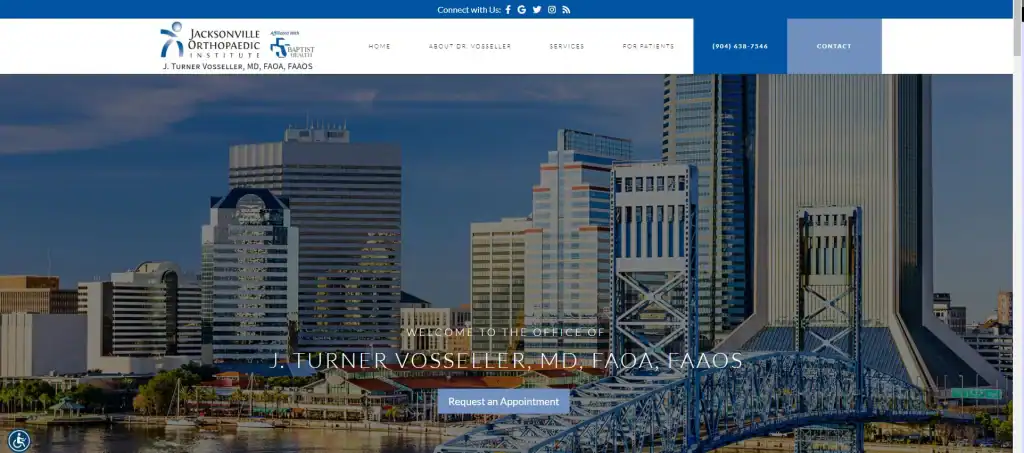
The homepage explains his minimally invasive approach, highlights bunion surgery, and links to a research publication on PubMed, which shows expertise rather than claiming it. A services menu of about 14 conditions, from Achilles tears to turf toe, gives each a dedicated page. A “Skip Menu” link helps keyboard users, and a “Last Updated” date in the footer signals the site is maintained.
3. Vipul Dua, MD (joint replacement, South Windsor, CT)
Vipul Dua, MD built the site around the procedure patients search for. The domain itself names robotic hip and knee surgery, and the homepage features dedicated banners for robotic-arm-assisted knee and hip replacement, plus a shoulder section.
The main call to action is “Request a Consultation,” which matches how surgical patients decide. The menu includes a Videos section, the homepage links to a newspaper feature about the practice, and the site states that it works with a large range of insurance plans and workers’ compensation carriers, an important detail for injury patients.
4. Rothman Orthopaedics (Pennsylvania, New Jersey, New York and Florida)
Rothman Orthopaedics shows how a large group handles complexity. The homepage opens with “Find a Doctor and Schedule,” a region selector separates its markets, and “Make an Appointment” sits in the top navigation and repeats down the page, with a link to online scheduling.
A “Get Care Today” link leads to walk-in and urgent care options, so acute injuries never land in the standard appointment queue. Quick links handle the existing-patient jobs: portal, bill pay, prescription refills, imaging upload and visit summaries. Patient ambassador stories and an “Accepted Insurances” link round out the trust signals.
5. OrthoCarolina (North and South Carolina)
OrthoCarolina puts two paths side by side in the header: “Schedule Appointment” and “Walk-In Today.” The hero, “Let’s Get You Moving,” has a single “Schedule Today” button linked to online scheduling, and a persistent “Get Care Now” banner stays on screen.
The homepage explains same-day orthopedic urgent care and extended evening and weekend hours, then moves to areas of expertise, locations and patient stories. A Pricing link sits in the utility bar, with price-transparency information under Resources, which is unusual and useful for patients comparing costs.
How should an orthopedic practice structure its website?
Structure the site around how patients search: by body part and condition, by procedure, by surgeon and by urgency. Each of those deserves its own page type, linked from a clear menu, so both patients and search engines can find the exact match.
| Page type | What it answers | Must include | Example above |
|---|---|---|---|
| Body part or subspecialty hub | “Who treats my knee, shoulder or spine?” | Conditions and treatments for that area, linked surgeons, booking button | Nutley Orthopaedic Group |
| Condition page | “What is wrong with me, and what are my options?” | Plain-language symptoms, non-surgical and surgical options, when to be seen | J. Turner Vosseller, MD |
| Procedure page | “Is this surgery right for me, and what is recovery like?” | Candidacy, technology used, recovery timeline, consultation CTA | Vipul Dua, MD |
| Surgeon profile | “Is this surgeon qualified for my case?” | Training, fellowship, board certification, procedures performed, locations | Nutley, Vosseller, Dua |
| Urgent or walk-in care | “Can I be seen today for this injury?” | Locations, hours, what is treated, what to bring | Rothman, OrthoCarolina |
| Location page | “Which office is closest, and when is it open?” | Address, map, hours, phone, surgeons on site, parking | Rothman, OrthoCarolina |
Smaller practices do not need every page on day one. Start with the body parts and procedures that drive your revenue and build outward. Our website design team plans this architecture before any visual design begins.
What makes an orthopedic website convert in 2026?
An orthopedic website converts when it is fast on mobile, separates urgent care from routine booking, works for people with disabilities, keeps health information off ad platforms, and uses structured data that matches the page. Each of these has a published standard you can test against today.
Pass Core Web Vitals
Google rates a page as good when its main content appears within 2.5 seconds, it responds to taps within 200 milliseconds, and its layout shift stays at 0.1 or less, measured at the 75th percentile of real visits on mobile and desktop (web.dev, 2024). Procedure videos and large hero images are worth having, but they should never block the first screen from loading.
Give injured patients a faster path
The two group practices above separate “get care today” from “make an appointment.” Even a single-office practice can copy that idea with a same-day line, a short urgent-request form, or clear hours for walk-in fracture and sprain care. On mobile, keep a sticky call or book button in view.
Make the site usable for everyone
Many orthopedic patients have limited mobility or use assistive technology. The Department of Justice says ADA Title III applies to businesses open to the public and points to WCAG for guidance, naming inaccessible forms as a barrier (U.S. Department of Justice, 2022). Practices that receive federal financial assistance, such as Medicaid payments, also fall under HHS’s Section 504 rule, which requires WCAG 2.1 Level AA by May 11, 2027 for recipients with 15 or more employees and May 10, 2028 for smaller ones (HHS interim final rule, Federal Register, 2026).
Keep intake and booking forms HIPAA-safe
HHS has said that tracking technologies on appointment-scheduling pages may disclose protected health information to vendors (HHS Office for Civil Rights, 2024). Part of that guidance was vacated in court in June 2024, but we still keep ad pixels and session-replay tools off every form and use HIPAA-compliant forms for intake, imaging uploads and consultation requests.
Mark up each location accurately
Google requires name and address in LocalBusiness structured data, recommends phone, URL, hours and coordinates, and asks for the most specific subtype (Google Search Central). Google also says AI Overviews and AI Mode need no special schema, only standard SEO and structured data that matches the visible page (Google Search Central).
Which orthopedic marketing channels bring in new patients?
For most orthopedic practices, new patients come from four channels working together: local search and Google Business Profile, paid search for high-intent procedures and injuries, online reviews, and physician referrals. A strong website is the shared destination for all four.
Local SEO and Google Business Profile
Patients search “orthopedic surgeon near me” or “knee doctor” plus a town. Each office needs a complete, accurate Business Profile with the right categories, hours and photos, and a matching location page on your site. Our local SEO work starts with those two pieces.
Paid search for procedures and urgent care
Search ads work well for terms with clear intent, such as joint replacement consultations or same-day sports injury care. Send each ad group to the matching procedure or urgent-care page, not the homepage, and track calls and form submissions as conversions without sending health details to the ad platform. Google Ads management for practices should follow those rules by default.
Reviews, earned the right way
Ask every patient for a review, not just the happy ones. Google prohibits offering incentives for reviews and selectively soliciting positive ones (Google Maps content policy), and the FTC’s 2024 rule bans fake reviews and incentives tied to positive or negative sentiment (FTC, 2024). When you reply, never confirm that the reviewer is a patient or mention their care.
Physician referrals and patient education
Primary care physicians, physical therapists and athletic trainers send a large share of orthopedic patients. Give them a dedicated referral page, a fast intake path and clear subspecialty information. Short educational videos and condition pages help both referrers and patients understand what you treat.
What should an orthopedic practice do this month?
Pick the items below that apply to your practice and assign each one to a named person with a due date. Most can be done without a redesign, and together they tighten every channel that sends patients to your site.
- On your phone, confirm a tap-to-call number and a book or request button appear on the first screen.
- Add or clarify a same-day or urgent injury path, even if it is a dedicated phone line.
- List every surgeon’s fellowship training, board certification and core procedures on their profile.
- Create or update one page for each of your top three procedures by volume.
- Run your homepage and booking page through PageSpeed Insights and compare against 2.5 s, 200 ms and 0.1.
- Check that no advertising pixels load on any intake, upload or appointment form.
- Verify each office’s Business Profile hours, phone and categories match its location page.
- Start a steady, policy-compliant review request after every visit.
Common questions
What pages should an orthopedic website have?
At minimum: a homepage, a hub page for each body part or subspecialty you treat, pages for your main conditions and procedures, a profile for every surgeon, a page for each location, an urgent or same-day care page if you offer it, a referral page for physicians, and a secure appointment request.
How do orthopedic practices get more patients online?
Combine a fast, well-structured website with complete Google Business Profiles for each office, search ads aimed at specific procedures and injuries, a steady flow of genuine reviews, and an easy referral path for physicians and therapists. Each channel should send people to the most specific matching page.
Should an orthopedic website offer online scheduling?
Yes, where your workflow allows it. Large groups such as Rothman and OrthoCarolina link online scheduling from the header and hero. If surgeons need to triage first, use a short secure request form and respond the same day, and keep a separate path for urgent injuries.
Can orthopedic practices use Meta or Google pixels to retarget website visitors?
Be very careful. HHS has warned that tracking on scheduling pages may disclose PHI. Keep pixels off all forms and condition-specific booking flows, and never upload patient lists to ad platforms without proper authorization. Use HIPAA-compliant forms for every intake and booking step.
How should an orthopedic surgeon respond to online reviews?
Thank the reviewer and invite them to contact the office directly, without confirming they are a patient or mentioning any treatment. Ask every patient for a review rather than only satisfied ones, since Google prohibits selective solicitation and incentives, and the FTC’s 2024 rule bans fake reviews and incentives conditioned on positive or negative sentiment.
Is a separate procedure website, like a robotic knee site, a good idea?
It can work for a practice known for one procedure, as Vipul Dua, MD shows with a domain built around robotic hip and knee surgery. For most groups, strong procedure pages on the main site are easier to maintain and keep authority in one place.